|
|
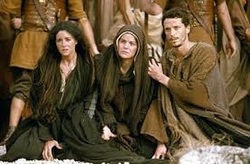 If you think about it, the week we now call Holy takes us through the full expression of human emotion.
The week begins with cheers and adulation, rings in with palm branches and children’s songs then moves to betrayal and abandonment to injustice and suffering and finally towards hope. What we have in the span of one week then, on the liturgical calendar, is an invitation into the darkness. For some of us we are relieved to finally have a season when our questions are valid, when our doubt makes sense, when our grief finds a home and we are not ostracized at our reluctance to celebrate the goodness of God in pithy unweighed theological statements like bumper sticker faith. For those of us who struggle in life lived with happy, clappy resurrection folk, who need a home for our lament, the cross allows us the space to ask, “Where are you God?” In fact, that’s exactly what Jesus asked, suffering as he was that day, life ebbing away on the rock of Golgotha. It is to Jesus I cling. It is to the story of the one who willingly suffered and died that I am compelled. It is to the one who prayed, “Father, take this cup from me,” who opened his eyes to find the cup still there and who drank deeply that I am drawn. If the truth be told, I am not sure I have reconciled to the God that allowed such agony to occur to his own son, to God’s own self, to lowly broken creatures like me, just trying to do our best in this world; why does such pain need to be known. This year as I walk through the Lenten season and into Holy Week, I am clinging to Jesus like Mary did, hoping, trusting, believing he will make some good out of all the pain. I need her strength, I need her courage, I need her understanding of suffering redemptive. As I walk through the darkness I am aware that this year it is not a mere liturgical season but the reality of my own life as not many weeks ago I stood over my own precious child—a nephew—gone too soon from us for reasons that are senseless and tragic. Like Mary, I anointed him with my tears, and I stayed with him until the end and I gave him back to God. It is in these moments of unspeakable agony when we, like Jesus, wonder where God can be found. We wonder how it is that we will make it through, and once more it is Jesus from the cross, thinking of Mary, and perhaps all of us who shows us the way. “When Jesus saw his mother and the disciple whom he loved standing beside her, he said to his mother, ‘Woman, here is your son.’ Then he said to the disciple, ‘Here is your mother.’ And from that hour the disciple took her into his own home” (John 19.26 ,27). Jesus knew his mother and his friends, he knew that we would have to go on, he knew that life is hard and tragedies happen and the world is blood soaked and broken. Jesus knew for those he loved life would continue, the sun would rise, the water would need to be drawn, the families would need to be fed, the laundry would pile up on the floor. Jesus knew what it was to suffer, to face the darkness and to feel as though God had abandoned you. He knew what it was to believe God could not hear your cries, had left you in your pain and Jesus knew, in those moments wrought with grief and loss, confusion and fear God could be found in the arms of someone who loves you, wrapped around you, bearing you up. In our sorrow, as we weep, as we struggle to find legs to stand, to remember to pay the phone bill and make grocery lists, as we remind ourselves to breathe in and out, we hold the hand of the one whom Jesus gave us, we lean in and we bear down and we remember in our loss we are connected, we are bound to Jesus and to each other, and in our bond God is found. Jesus showed us from the cross, this is how we make it through.
1 Comment
 As an associate professor of bible, I split my time between seminary and strip club because it is my fierce conviction that as the text impacts our lives, we should live accordingly. That is to say, I take seriously Jesus’ charge to be light and salt, I am compelled by his model of shared life and supper with outcasts; I am transfixed by the stories of whores who are also heroines in the plan of God.
If you look close enough, you start to discern certain patterns hidden up under the sacred text, all those stories concerning men, handed down by men, interpreted by men across the ages. If you press in, like the woman with the issue of blood and bend over to see what Jesus is doing in the dust, like the woman caught in adultery, you will begin to see a counter-narrative emerge; hope scribbled right into these manuscripts, texts read from the bottom up. When you catch it, you will realize with Hagaar that God sees you and you will laugh out loud like Sarah at the hope of a baby in her barren womb. God has always been on our side. So much like the strippers who are my friends, we tend to read the women of Scripture from the top down and thereby miss the wonder of God’s work before us. It is no accident that all the women named in the genealogy of Jesus are so called scandalous. Like so many women who we read about in the canon, these women were oppressed by a system that left them few choices save to trade their bodies to survive. Tamar disguises herself as a prostitute to lure her father in law to her bed so that she might have a child; Rahab, the harlot, welcomes the Hebrew spies and deceives her own king. At the impetus of her mother in law, Ruth dares to sneak to the threshing floor amidst a gang of drunken men to sleep next to Boaz so that he might take her for a wife; Bathsheba answers the king’s summons and becomes his concubine and the mother of his child. Mary is a pregnant, unwed teen who births forth the son of God. I often wonder if we knew deep the stories of women who went before us, would we be fortified. If we’d heard the stories scraped from the pages of the text, if they’d been relayed to us from the bottom up, from the point of view of woman, slave, victim of sexual abuse, warrior, sage, patrona, would we have received them differently, would we have been encouraged, would we have felt less alone, would we have a sense of our own worth and purpose in God’s plan? It doesn’t take long before you begin connecting the dots between the women of Scripture and sex workers, soccer moms and female seminarians, you begin to find much and more we have in common as women. These commonalities stretch across the ages, reach across religious tradition and geography and socio economic standing. Some of these commonalities, unfortunately, render us paralyzed, unaware of our own divine, feminine power. We are, all of us, afraid. Whether you take your clothes off for money or are scrambling to pack the perfect snack for the team or are working on the final draft of a manuscript for the last two years; we are convinced we are not enough. Women who lead conferences, convene boards, sell their bodies for a living are terrified that someone will find out what we believe is true, we are worthless and wayward, overweight and over obsessed, too thin or too loud, not educated enough, not experienced enough, not credible enough, not smart enough, not beautiful enough, not …enough. Most of us, it seems are starved and searching for stories of hope, stories of survival, stories of women who made it through the struggle, who found a way through the pain, to see and know God as manifest in feminine form, to be able to find ourselves in the miracles of Jesus and borne up on Spirit wings. To this I say, receive the Good News of Christ who rescues, redeems, restores; the Lord your God is on your side. Travel with Kimberly to Greece/Turkey to study women of the New Testament up close and personal May 2014. For more information click here. 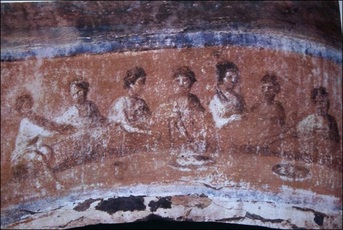 Fracctico Panis, Catacombs of Priscilla Below freezing outside, the ground blanketed with new fallen snow, they come in from out of the cold, wet galoshes and heavy down coats dropped by the door. It is Friday morning, mid-winter in Indiana and they bring butter cake, cranberry muffins and clementines; the flames dance in the fireplace, the coffee pot hisses fragrant hot steam and we come together and thaw.
My home, visited by wisdom personified: women, leaders, ministers, seekers, sisters, daughters, mothers, mentors. We sip our coffee and share our lives. There are new babies to brag on, photos of the living dolls to pass around and fawn over, there are stories to tell, ground covered on the journey from last time until this. There are miracles to claim, praise to be given for those angels keeping watch, there are burdens to share, there is pain to confess. We laugh and eat and testify and my mind drifts to a place like this before us. Far below the centuries of civilizations long come and gone on the Aventine Hill in Rome there lies a chamber beneath the rubble, inside the ancient Catacombs of Priscilla. Beautiful reliefs are painted on the wall throughout, images of women, pillars of the early church, Mary the Virgin, Theodora, Thecla and the Magdalene, their stories of surrender and grace all but lost to us now. Except for this funerary chamber, this cavern in the ground, this shrine for women valiant in the faith, this safe space where it seems they gathered for centuries to worship in Jesus’ name. It is no secret to any student of Scripture that there was a time in the early days of the community of the baptized when women taught and encouraged, led and gathered the believers into their homes, those safe abodes and first sanctuaries of early Jesus followers. Even in the turmoil of the first centuries, in the midst of the struggle for identity and the battle to sustain what the Spirit had birthed, we find these sacred places hewn in the stones of the earth where holy women gathered to share the Lord’s meal to kneel and pray. After the sanctuaries of the home had been abandoned, given way to cathedrals, long after women had been silenced in the church, still they gathered and we know some came here, to Priscilla’s Catacombs to this chamber because they believed it to be the resting place of St. Prisca, early church leader and ministry partner of Paul. An ancient fresco is stained into the stone commemorating seven women gathered together to share the Feast of the Lord. I sample the butter cake and I think about them and us, all women, all called, all struggling to stand and sustain what the Spirit has birthed. I think about how much we all need each other, how grateful I am to have been visited today by my wise companions, those gathered now and those who gathered before us. I raise my hands and I give thanks for women wise and sacred space.  I scramble to find the Christmas lights in the garage that is still cluttered with boxes from our move, tripping over first one thing and stubbing my toe on another; I swear under my breath as the Silent Night plays in the other room.
For weeks I’ve been trying to beautify my home, to hang ornaments and Douglas fir swag’s, to fill the air with cinnamon and clove hoping the loveliness will cover the hurt and fear of this season. As I make my usual preparations, I am acutely aware there are faces missing from the scene this year, loved ones who once filled the halls with laughter and warmth whose absence leaves us with an empty longing ache. There are relationships that are shattered and broken pieces of us lying on the floor, there are dreams that did not come true staring back at us from the holly covered kissing ball. My cat, still unsettled in the new home has peed on my tree skirt twice so that I am afraid to wrap my gifts and seal them with bows for fear my loved ones will find more than what they hoped for in the box gilded with love. ‘Perfection is a myth’ I chant as I remember the words of my therapist from ions ago. I drive to Starbucks in the drizzling rain of early December that should be fluffy white snowflakes the size of my hand and I think of her as I so often do this time of year. If anyone had expectations of how things ‘should be,’ if ever a woman dreamed of how the miracle of Christmas might come to pass it was Mary. Had she and Joseph argued about the ill timed trip to Bethlehem, had she complained and asked him to walk faster so they might make it into the city in time to find a room? Was she driven to tears and exhaustion by the sorry excuse for lodging that was afforded them, was she angry when the uninvited guests arrived unannounced? If any of this is true, we have no record of it; we only know these imperfect memories, this ramshackle scene, this inelegant birth was precious to her so that she thought about it often and treasured that night in her heart (Lk. 2.19). It strikes me that her response is so different than mine. Faced with fear and uncertainty, I respond with a fierce furious need to control, dragging everyone with me, kicking and screaming doing what I can to force what ‘should be.’ Mary found the grace and sweet blessing of accepting what is. I don’t know what things look like around your table this year, not sure if your traditions will endure or if life or hardships, natural disasters or economic woes threaten your long held ways. It is possible that your turkey will be dry and your relative will step out of line but remember this; the miracle of Christ often finds its way into the worst possible situations. The hope of Christmas is more than some preconceived notion or Norman Rockwell image, it is born in love, hewn in the rock of surrender, known in the acceptance of what is here and now. May the peace of Mary and the wonder of her Son dwell with you this season and may you know the joy of living right where you are.  In those days Mary set out and went with haste to a Judean town in the hill country, where she entered the house of Zechariah and greeted Elizabeth. When Elizabeth heard Mary’s greeting, the child leapt in her womb. And Elizabeth was filled with the Holy Spirit and exclaimed with a loud cry, ‘Blessed are you among women, and blessed is the fruit of your womb. And why has this happened to me, that the mother of my Lord comes to me? For as soon as I heard the sound of your greeting, the child in my womb leapt for joy. And blessed is she who believed that there would be* a fulfillment of what was spoken to her by the Lord.’ Luke 1. 39-45 (NRSV)
I have never liked hospitals. The way they smell like cleaning products and watered down gruel. I have never liked the way shoes squeak on the linoleum tile or that the hallways are cluttered with space age machines and gurneys and bed pans. Never mind the fact that the inhabitants of the hospital are sick folks, which makes the whole experience like descending into a universe of perpetual germs. As much as I dislike hospitals, you would think I would have avoided them. However, they have inevitably been a part of my life. Not that I have ever been a patient myself, thankfully, up to this point, I have been blessed with good health and have therefore only been there to visit and bring spiritual care to others. For my familiarity of hospitals, and for many other things, I blame my mother. A woman who was ever eager to visit hospitals and nursing homes and places where mentally handicapped kids lived, my mother spent most of her life loving old people or sick kids or needy friends. |
Subscribe Today for Free GiftBLOG

Archives
July 2019
Categories
All
|
 RSS Feed